- FORREC planned and designed Canada’s Wonderland (opened in 1981). The first huge theme park in the countries’ history.
- It’s all about “visitor experience”. People are shopping to forget their problems and watching Netflix in their basements then get together and share experiences/”moments”.
- There were amusement parks before Disney but today it’s about branded parks. Universal Studios, Legoland: people want to see and feel the brands. Disney Carnival Cruises is a huge market.
- Canada’s Wonderland would not be built today, now it’s about integrated developments (“a destination, “a place to go” “mixed use” “retailtainment”).
- As shopping changes its about finding ways to draw people in.
- FORREC did Expo 67 (some pavilions). At the time FORREC was a landscape architecture company (did Ryerson, Eaton Centre etc.). Clients said “can you do this?” and we said “why not?”. We do wayfinding, creative, graphic design etc.
- Question: what about Toronto gives you the edge? Answer: there are 28 languages spoken in our office. FORREC has 140 employees in Toronto. “We’re Canadian” (we care, listen, are thoughtful, respectful etc.). There’s an office in Shanghai (offices in USA -Orlando/LA- as well but more for business development).
- FORREC has done projects in Vietnam, Korea, Dubai (it’s handy to have employees from there who understand cultural subtleties). It doesn’t matter if people have a license to work here or not because we’re working globally.
- We’re more global, not really known locally and that makes recruiting people a challenge.
- We’re not focused on awards rather servicing clients
- Did a project for AS Roma (client was googling around for designers) to build a football stadium.
- What we’re really strong at is mixed-use developments (single use doesn’t make sense revenue wise). RDE: retail, dining, entertainment. “Retailtainment” experience.
- A major consideration: how do you engage people? How do you handle crowds and keep them there. People don’t come for just one thing, it’s about having multiple aspects.
- We’re working on Legoland Shenzhen (just across causeway from Hong Kong). We did Legoland Germany. Legoland now integrates resorts.
- FORREC services the project from end to end as the design people and deals with speciality consultants. Random example of complexity: the necessity of having no variance in the electric current when dealing with screens.
- You have three clients: developer, brand and end user.
- In China they are scared their culture is a disappearing so have to be more culturally sensitive. There’s this dichotomy around western brands: they want them but you have incorporate the local aspect and it’s tricky because the brands want to be true to themselves. In China they have large integrated visions.
- Our industry is different, it’s not just matter if creating a commercial centre as there are special considerations. We get hired to do visioning. The feasibility study is where projects live or die.
Category: Architecture
Completely dead space in the city
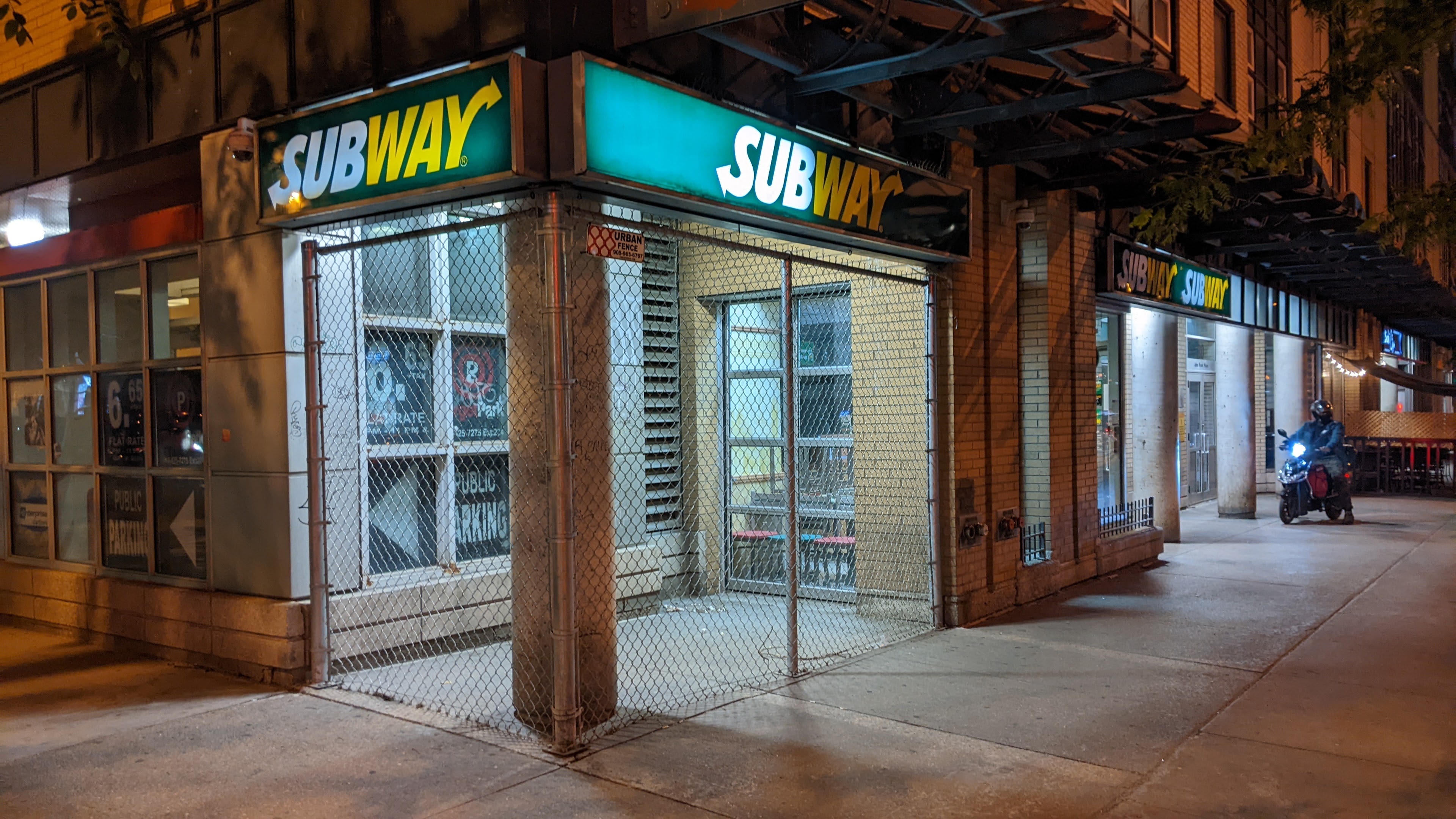
This photo of a storefront in downtown Toronto shows completely dead space. The chainlink fencing was recently installed making it newly dead space. I’m sure there’s an urban planning term for this type of situation.
Since the coincidence of Covid-19 and a huge run up in local housing costs, Toronto’s city centre has entered a whole new era of “houselessness” and street life. Basically, Toronto now has an “underclass” in the style of a USA city. This fact is obscured somewhat by a policy of hoteling the houseless.
It’s safe to assume that this fencing is a response to the new social situation. This “Subway” location happens to be across the street from one of the hotels functioning as temporary housing for a bunch of people on the wrong end of things.
Presumably the property owner is entitled to fence in his or her property even if it’s effectively been part of the sidewalk over the long term and even if there are no entrances (or anything else) to enclose.
This particular example of dead space really draws the eye as it’s well lit, in a high trafficked area and features a window into a busy retail location. It’s like a glowing cube.
daily notes #5: R. C. Harris Water Treatment Plant exceptionalism
If you aren’t an architecture person the only Toronto landmark that’s worth going out of your way to see is the R. C. Harris Water Treatment Plant. Countless other pieces of internet writing will give you a précis of the institutions history. This one won’t because it’s the 2020’s and there’s no timeline, only an array of moments.
Downtown Toronto’s aesthetic chaos and speed aren’t given to… virtually anything. It’s best to embrace the void but R. C. Harris is far enough from the core that you’re completely abstracted from it as a treat. It’s separate and distinct even in its immediate context.
The plant’s interior is Toronto at its most first-half-of-the-20th-century. What’s your middling grab bag of aesthetic references? Anyways, it’s Art Deco. Everyone likes that. Time and place, it’ll put you there. A Canadian Gesamtkunstwerk? It was at least a possibility.
Can’t get inside? The overall site is still an experience. On entering the front gate a hairpin road guides down to the lake. Looked at from outside the buildings have an abattoir-vibe. In daylight any creepiness is undermined by the fun facades. At night you can lean into it.
No piece of Toronto public grass is manicured like the R. C. Harris lawn. A curving railing contours the divide where the groomed grass meets the sparkling water’s edge. Here, you can pretend you aren’t anywhere. A flat plane greets a flat plane and there’s nothing nearby.
There’s something very sensual about it. Music videos and fashion photography are shot at this exact spot for a reason. The R. C. Harris grounds are a make-out spot for east-end teenagers who, when kicked off, keep partying on the endless beach that starts just steps away.
Forget about the interior, it’s almost never open to the public anyway. Instead, aim to be at R. C. Harris for sunset on a summer night with a full moon. Have dinner on Queen St. first and then ease down to the water. As the sun sets start west along the sand.
Witold Rybczynski on architecture as “fantasy”
“Whether one is looking up at the tall dome of the Pantheon, descending the spiralling vortex of Wright’s Guggenheim Museum, or standing in the living room of Venturi’s small house, the experience of architecture is above all the experience of being in a separate, distinct world. That is what distinguishes architecture from sculpture -it is not an object but a place. The sense of being in a special place that is a three-dimensional expression of the architect’s imagination is one of the distinctive pleasures of architecture. To create a strong sense of place, the surroundings must be all of a piece; space, mass, shapes, and materials must reflect the same sensibility. That is why details are so important. A jarring detail or an inconsistency -something “out of place”- and the fantasy begins to crumble. Yes, fantasy. Illusion has been a part of architecture ever since the ancient Greeks made columns with a gently swelling taper to deceive the eye. This is not to say that architecture is stage décor. When the wind blows, the canvas scenery blows over; the building resists the elements. Architecture surrounds and shelters us. It is the real world but it is also a vision.”
 davidhadwen's website