Lessons From Toronto – Jennifer Keesmaat On Complete Communities

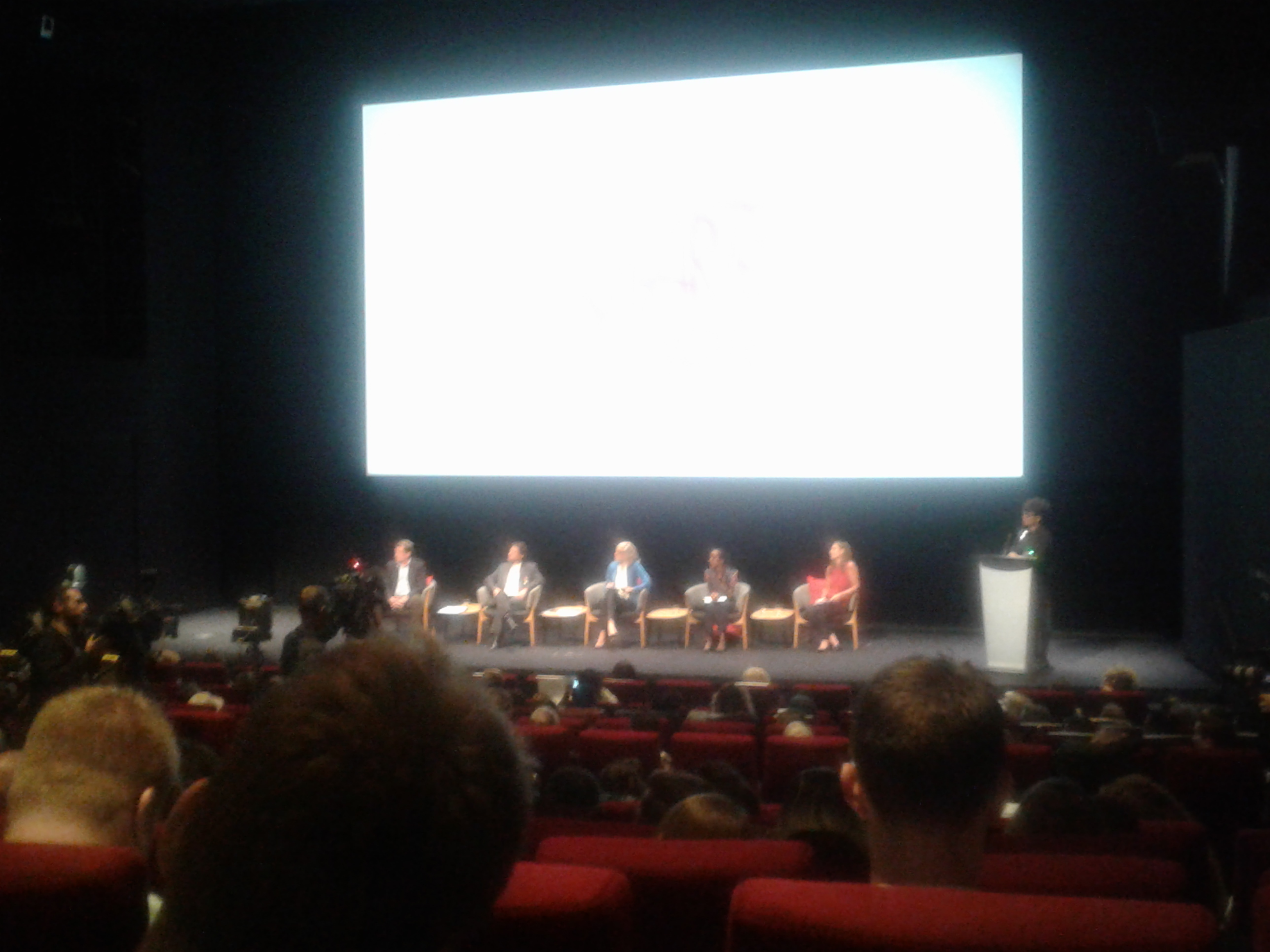
This image shows Jennifer Keesmaat at a Toronto mayoral debate.
Keesmaat (centre in blue) running for Mayor in 2018.

Jennifer Keesmaat was once Toronto’s chief urban planner and ran for mayor of the city in 2018 (she lost badly). These are notes from a presentation Keesmaat delivered on “complete communities”.

  • Toronto is the third largest region in North America by population. It’s one of the largest tech hubs outside Silicon Valley and the financial capital of Canada.
  • Over 50% of Toronto is foreign born. Immigration and refugees are seen as central to the city’s character and economic growth. It’s “a beacon”.
  • The hook that brings together every single planning decision: vibrant neighbourhoods and complete communities.
  • This opposed to a live/work view with “super fast highways” that take you from one place to another.
  • Affordable housing will be achieved by planning for it and recognizing it as part of every complete community.
  • Toronto has the unfortunate honour of making the list of the most expensive cities. There’s been a complete seperation between local wages and house prices.
  • “The market can no longer provide affordable housing for all.”
  • Housing has become commodified, an asset to be traded, something to generate wealth vs. a vision of housing as a home (where families “eat dinner”).
  • If we don’t get this right (housing), who cares about walkability, who cares about complete communities, who cares about sustainability, if we’re only designing for a small and lucky portion.
  • An affordable high quality transit system is the backbone that allows complete communities to be connected. It enables the option of never needing to own a car.
  • A vibrant downtown designed for connectivity and innovation that can attract and facilitate stable and high paying jobs is essential to the overall health of the city. The complete community vision has the creative economy in mind.
  • All nine of our beaches in Toronto are “blue flag beaches”. Clean air and water right where people live is a part of the complete community vision.
  • Green spaces of a variety of different sizes and public squares that bring people together. When we design public spaces right they provide for spontaneous interaction that expands the humanity of everyone in our cities.
  • Options for recreational activities should be provided. The notion that you have to leave the city for outdoor recreation is an old model. With complete communities you can walk out your door and undertake recreational activities in close proximity to home.
  • How we design and plan our waterfront is critical to ensuring that our waterfront is a shared asset, not an asset only developed for the super wealthy which was the old model in Toronto (the wealthier the closer to the waters edge). The waterfront should be a shared resource where we can all come together.
  • Cultural facilities that celebrate the best of city living are an important part of complete communities, they help us tell our story and understand ourselves.
  • When we get architecture and urban design right that becomes a magnet for people and we astonish/inspire as part of everyday life. Complete communities are intentional about design and don’t leave it as something that’s superfluous but rather essential to how we live together.
  • All growth isn’t good but when we get the design right, have mixed-use and attend to streetscape we can deliver places that are livable.
  • The greenbelt is a matter of emphasizing where growth WILL NOT go in order to assert where growth will go. The greenbelt is the policy framework for the transition from sprawl to density.
  • One of the other drivers of change in the GTA is shifting consumer preferences. Millennials have a fundamentally different preference and want to walk to work (either driven by experiences with commuting or environmentalism).
  • We want to attract the 16-34 demographic because Toronto’s vitality is contingent on attracting young people into the core.
  • When we paint this vision of the future, of complete communities, the vast majority of the public put their hands up and says “I’m in”.
  • Very few people in the overall Toronto region can walk to work. In the downtown core its 75%. But when we scan the entire region and give people choices many would take a smaller house adjacent to transit (36%).
  • Queens Quay makeover: generous public realm, separate bike lanes, prioritizing the transit corridor.
  • Recent adapation of taking the cars off a transit corridor (King Street).
  • Private investment is responding to the opportunity of providing walkable communities where people can live work and play right within their neighbourhood.
  • The Greenbelt has driven growth into the core. The area of the city that’s the most walkable with the best transit and the best parks is growing four times faster than elsewhere. If we can create walkable communities everywhere can we attract investment everywhere? Can we begin to adapt the city in a variety of different places? Growth follows consumer preference and sustainability increases.
  • But this only happens when we link employment with residential growth. The two must be linked together to deliver on this option/opportunity (of complete communities).

How Toronto Switched From Buildings And Infrastructure To People And Complete Communities

1. Detailed Precinct Planning

The details matter. We have to deliver on the ground level. Prioritizing the public realm is essential if we add density. We have to think about public space and pedestrians first rather than the character and quality of individual buildings.

2. “Extreme” Mixed-Use (The Distillery District)

In the distillery district over forty buildings are linked by an exclusively pedestrian realm. These are Victorian era buildings. It’s a college campus, there’s light industry, it’s an event venue, there’s a brewery, it’s a residential neighbourhood, an employment district, a district for artists, a place for children and senior citizens. We broke all the rules and it’s a place people want to be.

3. Strategic Site-Specific Infill

A big part of planning is urban repair. Neighbourhood example of Sheppard and Don Mills: we added new density to a poorly serviced suburban area, added buildings to create main street retail, added community and social events, added a library, a school and community centre. There were no clear public spaces and places for pedestrians. The “beacons” (public art) draw pedestrians into the site and terminate in the neighbourhood where theres a new school, pool, library and community hub. This is urban repair and not “one use” thinking. There’s a new subway station at this location. Adapt the urban environment and deliver the dream of walkable communities.

4. Urbanizing Avenues: Adding Density And Creating Main Streets

The Golden Mile: repairing and transforming the environment. A new LRT will serve as the backbone for how people can move. Also adding cycling infrastructure and widening sidewalks. Adding green infrastructure, new mid-rise buildings and a mix of uses. An old suburban street transforms into a complete new community.

5. Urbanizing Classic Suburbs (Gentle Density And New Housing Types)

Humbertown: a 1950’s strip mall, the adjacent area is very green with ranch-style 1950’s suburban homes. There’s nowhere you can go within walking distance of your home. Transformed: all parking put underground, green roofs, new public square in the centre. You can downsize by moving into a new multi-residential unit of seniors housing. New retail has been added to complete the hub.

6. Adaptations In The Public Realm

We’ve wanted to link together the public spaces in Fort York and the waterfront. Adapting the infrastructure below the highway that currently creates a barrier between eight different hoods and the rest of the downtown core.

7. Transforming The Discourse

We need to talk about the city in a different way, talk about about how we might live differently, why this matters and how we can elevate quality of life. We’re changing rapidly and the risk is that people will resist change if they don’t buy into the rationale of why this is good and valuable.

None of this matters if we don’t get affordable housing right. We’ll be designing places that only get more and more exclusive.
“How Toronto Lost Its Groove” John Lorinc’s Toronto Mega-Take 10+ Years Later

“Yet in Toronto… well, Torontonians complain endlessly about congestion but refuse to give their political leaders the tools to do anything about it. They boast about the city’s ethnic diversity but don’t much mind if immigrants are warehoused in vertical ghettos. They aspire to live in a creative-class city with serious cultural ambitions, but only if they can pay Walmart prices.”

  • Gridlock and congestion have major costs in lost productivity, no transit improvement so roads “bursting”.
  • Sprawl continues unchecked, increasing cost of municipal services.
  • “Should the rest of Canada care? Yes, because the GTA is the country’s economic hub, accounting for one-fifth of its gross domestic product; New York, by contrast, produces just 3.3 percent of the United States’ national income.”
  • “…tens of billions more in tax revenues flow out of the GTA than come back in the form of services and public sector investment, which means GTA wealth subsidizes government services across Canada, including health care and social security.”
  • METRO Toronto was created in 1953 and seen as a success, admired.
  • Bill Davis established two tier government in the 905 and this was the GTA’s “original mistake” as powerful municipalities compete for public and private investment
  • In 1994 Ann Golden proposed a Greater Toronto Council for greater services (transportation, waste management, and economic development), leave lesser services for cities (essentially METRO for the GTA).
  • “Despite Harris’s ambition to reduce government, the GTA remains staggeringly over-governed, with 244 municipal office holders, including twenty-five mayors. By comparison, New York, with 8.3 million residents, is governed by fifty-one councillors, five borough presidents, and just one term-limited mayor.”
  • The Ontario government is reluctant to create something like a Greater Toronto Council as it doesn’t want a political rival or to be seen as favouring the GTA.
  • “But in the 1980s and 1990s, as development took off north and west of Toronto, the municipalities of Vaughan and Markham enthusiastically pursued beggar-thy-neighbour tax policies that enticed businesses to avoid or flee Metro and its higher commercial and industrial taxes. The result: a slow but painful decline in Metro’s non-residential tax revenues; growing tracts of fallow land; and fewer jobs in the inner suburbs, such as Scarborough and East York.”
  • Harris took responsibility for education from municipalities and downloaded transit, housing, parts of welfare.The TTC was aging at this point and province absolved itself, services were cut and plans stopped.
  • TRBoT study predicted 1billion shortfall by end of decade and suggested cut/priv. vs. new revenue “sales taxes, hotel occupancy levies, and parking fees” suggested by others (David Miller brought in vehicle registration and land transfer taxes).
  • The Ontario government spent on commuter rail and bus service, municipalities did not invest.
  • None of what was proposed in the 1975 Metro Toronto Transportation Plan Review was built, Network 2011 (1985) included three new subways. Harris cancelled one and only partially funded another. Harris believed transit should be funded by munis but eventually reversed and funded GTA commuter rail.
  • Liberals/McGuinty set up Metrolinx in order to take the politics out of transit planning (vs. Greater Vancouver’s TransLink, Metrolinx does not have predictable revenue, relies on provincial govt.)
  • The argument for David Miller’s Transit City: bring LRTs to suburban areas that could not support subways at 1/10th the total cost. Province, initially on board, scaled back funding and Ford cancelled all lines but one (Eglinton) and said to go underground. The same politicians who approved Transit City approved Ford’ in gutting it’s gutting of it.
  • The GTA is the world’s most ethnically diverse metro by proportion of foreign born residents, four in ten immigrants to Canada settle in the GTA.
  • Class polarization: Hulchanski study and decline in middle income neighbourhoods.
  • The GTA takes the lions share of immigrants but lacks the resources to absorb them.
  • In the 1970’s a federal Liberal government built co-op housing, in 1980’s Mulroney pulled out, Chretien continued cuts in 1995 and Mike Harris downloaded housing.
  • Affordable housing now has a “market-oriented, self-financing formula”.
  • Affordable private rental has not been built so many immigrants live in 1960’s towers “Toronto contains more suburban high-rises than any other North American city”.
  • A 2006 report called Poverty by Postal Code 2: Vertical Poverty highlighted spartan buildings, disrepair.
  • The 2005 Greenbelt Act and Places to Grow Act set a target of 40% of new development into urban areas.
  • “virtually no connection exists between land use and transportation planning”
  • 2011 study: 54% percent of GTA’s 200 million square feet of office space is far beyond the reach of rapid transit.
  • “The net result: Toronto, like many large North American cities, is now ringed by a huge band of intensely car-dependent suburbs.”
  • Development charges treated infill and greenfield the same, effectively subsidizing sprawl.
  • Kyle Rae pushed for expropriation to create Y-D square, politicians and landowners fought the vision but he prevailed. Kyle said/says “we have a culture of no”.
  • Toronto has a poor public realm, trash cans are bad, trees die.

“Six decades after the beginning of its epochal postwar transformation, it’s fair to say that Toronto has become a very big city, and a somewhat accommodating city, but not a great city—at least not yet. Which is more than a little strange, because the GTA contains an abundance of talent and energy, tremendous wealth, and intimations of a distinctly Canadian cosmopolitanism. What’s lacking is the will to abandon the story Torontonians have always told themselves, which is that they can’t afford the things big cities need and crave, that they mustn’t exercise the political clout that naturally accrues to large urban regions, and that they shouldn’t manage growth in the intelligent way that the twenty-first century requires.”

“Fixing Our Public Transit” with Reece Martin (RMTransit) & Arash Oturkar

These are notes from a panel at Hart House (UofT) hosted by the Hart House Student Social Justice Committee. The speakers are noted transit commentator and Youtuber Reece Martin and Arash Oturkar of CreateTO. Remarks aren’t always specifically attributed and this is not a comprehensive record.

  • CreateTO is an arms length agency of the city set up to manage it’s real estate portfolio.
  • Lots of plans: The Planning Act, the Provincial Policy Statement, the Growth Plan, the Official Plan, zoning by-laws and other guidelines.
  • Transit-supportive development: the growth plan includes MTSA’s (more significant within the Greater Golden Horseshoe). The Building Transit Faster Act includes four priority projects in the GTA (the Scarborough subway, Eglinton, the Ontario Line, Yonge North). Also relevant: the Transit Oriented Communities Act.
  • Transit Oriented Development (“TOD”) is site specific vs. Transit Oriented Communities which encompass a wider district.
  • All cities are required to have an official plan. The Toronto official plan identifies MTSAs as sites with major transit nodes in ten minutes walk or 500-800 metres (basically the transit lines already and those coming).
  • Parking too expensive/wasteful. The cost of underground parking space is 50k to 160k and two parking spaces take up the space of one apartment. The cost of construction is passed on to households (Toronto got rid of parking minimums).
  • Other planning considerations: Toronto Green Standards (transit and active transportation), RapidTO (Kingston Rd.), Toronto Poverty Reduction, Vision Zero, King Street Transit Priority, Bike Share, ModernTO.
  • Transit in the downtown core is three times better vs. the inner suburbs.
  • 36% of total emissions are from transportation, 80% of that from private vehicles.
  • Big picture: TOD is DENSE AND MIXED DEVELOPMENT BY TRANSIT.
  • Housing Now is investing in city-owned land to create affordable housing.
  • Bloor-Kipling “Six Points” (Bloor, Dundas, Kipling) was originally built in the 1960’s (car oriented). It’s a bad neighbourhood for pedestrians as areas were/are disconnected. The city intended to connect it (a two decade project of reconfiguration including simplified pedestrian way-finding for ex.).
  • Redevelopment includes a new Etobicoke Civic Centre, 2300 residential units, an elementary school, district energy. This is in partnership with a private developer.
  • 158 Borough Dr. in Scarborough Centre: a parking lot turned into housing that will have 650 units and a daycare. In walking distance of Eglinton and a future subway station.
  • Borough Dr. currently has fast vehicle speeds, the aim is to improve public realm (Vision Zero).
  • Key: parking lots near well served transit stations.
  • Question on gentrification: the city has been downloaded responsibilities, too much subsidy would be necessary for projects to be 100% affordable, land is very expensive, market units subsidize affordable units.
  • Question on stakeholders: Reece “you have to piss off David Miller”.
  • Question on resilience: TTC has reduced service (Reece raises “death spiral”), current head of the TTC ran York transit and has a “Samaritan” view. Ridership is thanks to “good, reliable service”.
  • Question about politics/voting (including anti-Ford comment and premise that we are the only jurisdiction that pays at fare box vs. subsidy): the TTC is not the only system that relies on fare box recovery (actually a good thing as it means efficiency), the risk with subsidy is that it could subsidize inefficiency. When Doug Ford got elected he didn’t cancel the Finch west LRT.
  • We’ve needed the “downtown relief line” since the 1970’s but there was a desire push development out of city centre.
  • Reece: there were bad elements to David Miller’s Transit City plan like Eglinton and Sheppard East. Jane and the waterfront are current go-forward priorities.
  • Arash: “planners make recommendations, politicians make decisions”, “in this job you can’t be pessimistic”.
  • Going virtual helped get more diversity to planning consultations.
  • Suburban ethnic areas like Thistletown and Brampton were surprised they were being consulted (research at TMU).
  • “A lot of great things have been in our planning documents for decades” but outcomes have been bad as you can twist things, find loopholes etc.
  • Cars are bad: environment, society, people’s health, the roads.
  • Jane street corridor: “we should just paint the lanes” ie. give buses their own lanes.
  • Reece: the MTSA at every single rail stop has the same radius, higher capacity should mean a wider area of impact (we need to be more sophisticated).
  • Question on TTC safety: the TTC is safer than driving statistically speaking, Toronto’s homicide rate is low. That said, “there’s a lot more anti-social behaviour”.
  • Reece favours free/low fares for certain groups but not across the board so there’s a price signal as transit is very expensive to build (free fares lead to very short pointless trips).
  • Overall topic of industrial zones/employment: “loading bay issue” limits options with industrial redesign, “industry sprawl is a huge issue”, in Vancouver there is a huge shortage of industrial land, it’s very expensive to do multilevel industrial.
  • Question about the desirability of high-rise development in the suburbs: the land value explodes where you build transit, perhaps there is a way to bring strip mall tenants back.
  • “Suburban retrofit” is a cool concept but there is a permanence to the sprawling environment.
  • Reece: can we go back to large floor plates? “Vancouverism” is going to be the death of us.
  • Toronto has way better bus service than most cities.

Transit Oriented Development? Mississauga’s LRT and Condo Building (I Wrote Something)

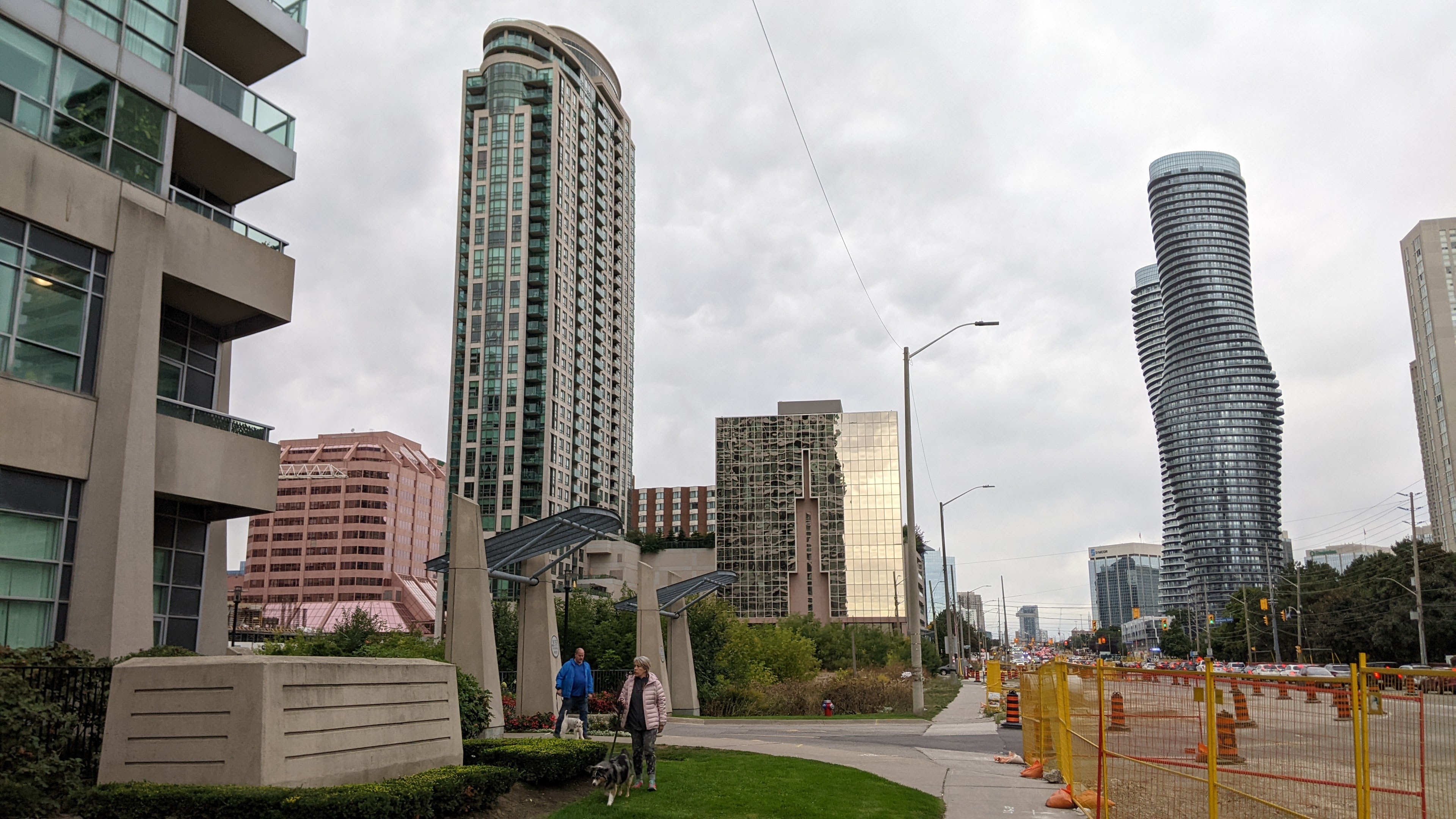
Suburban styles including the “Marilyn Monroe” buildings at Burnhamthorpe and Hurontario.

I’m interested in what’s called “transit-oriented development”. TOD aims to maximize the amount of walkable urban life near public transit and thereby increase transit ridership by reducing reliance on private vehicles.

On a related note, I recently wrote a guide to the condo projects being built around a light rapid transit project in the Toronto suburb of Mississauga. While it’s written with immediate business interests in mind, it’s still one of the more informative things on the internet about the project.