Steve Bannon, gaming and “these rootless white males”

“Bannon made another decision that wasn’t immediately obvious but that would have a significant effect on the size and nature of Breitbart’s audience and eventually on the 2016 presidential campaign. He wanted to attract the online legions of mostly young men he’d run up against several years earlier, believing that the Internet masses could be harnessed to stoke a political revolution. Back in 2007, when he’d taken over Internet Gaming Entertainment, the Hong Kong company that systemized gold farming in World of War craft and other massively multiplayer online games, Bannon had become fascinated by the size and agency of the audiences congregating on MMO message boards such as Wowhead, Allakhazam, and (his favorite) Thottbot. ‘In 2006, 2007, they were doing 1.5 billion page views a month,’ he recalled. ‘Just insane traffic. I thought we could monetize it, but it turned out I couldn’t give the advertising away.’ Instead, the gamers ended up wrecking IGE’s business model by organizing themselves on the message boards and forcing the companies behind World of Warcraft and other MMO games to curb the disruptive practice of gold farming.

IGE’s investors lost millions of dollars. But Bannon gained a perverse appreciation for the gamers who’d done him in. ‘These guys, these rootless white males, had monster power,’ he said. ‘It was the pre-reddit. It’s the same guys on Thottbot who were [later] on reddit’ and 4chan-the message boards that became the birth place of the alt-right.

When Bannon took over Breitbart, he wanted to capture this audience. Andrew Breitbart had drawn a portion of it enchanted by his aggressive provocations on issues such as race and political correctness. Bannon took it further. He envisioned a great fusion between the masses of alienated gamers, so powerful in the online world, and the right-wing outsiders drawn to Breitbart by its radical politics and fuck-you attitude. ‘The reality is, Fox News’ audience was geriatric and no one was connecting with this younger group,’ Bannon said. But he needed a way to connect. He found it in Milo Yiannopoulos, a gay British tech blogger and Internet troll nonpareil.

The purpose of all this incitement, at least in Bannon’s mind, was to entice the online legions into the Breitbart fold. ‘I realized Milo could connect with these kids right away,’ he said. ‘You can activate that army. They come in through Gamergate or whatever and then get turned onto politics and Trump.’ In this way, Breitbart became an incubator of alt-right political energy. Although Yiannopoulos was most interested in cultivating his own celebrity -Bannon thought he looked like ‘a gay hooker’- he was more than willing to do his part and make the political connection explicit. ‘How Donald Trump Can Win: With Guns, Cars, Tech Visas, Ethanol… And 4Chan’ read the headline of an October 2015 article he wrote.”

Goebbels on Radio

“The old regime was content simply to fill empty offices or change the faces, without however changing the spirit and content of public life. We on the other hand intend a principled transformation in the worldview of our entire society, a revolution of the greatest possible extent that will leave nothing out, changing the life of our nation in every regard.

It would not have been possible for us to take power or to use it in the ways we have without the radio and the airplane. It is no exaggeration to say that the German revolution, at least in the form it took, would have been impossible without the airplane and the radio.

It is in fact a modern revolution, and it has used the most modern methods to win and use power. It therefore does not need saying that the government resulting from this revolution cannot ignore the radio and its possibilities. To the contrary, it is resolved to use them to the fullest extent in the work of national construction that is before us, and in ensuring that this revolution can stand the test of history.

As in all other areas, the changes are primarily spiritual in nature. The radio must be brought out of the stubborn emptiness of its technical limitations into the lively spiritual developments of our age. It is not possible for the radio to ignore the times. More than any other form of public expression, it has the duty to meet the needs and demands of the day. A radio that does not seek to deal with the problems of the day does not deserve to influence the broad masses. It will soon become an empty playground for technicians and intellectual experimenters. We live in the age of the masses; the masses rightly demand that they participate in the great events of the day. The radio is the most influential and important intermediary between a spiritual movement and the nation, between the idea and the people.

The more committees, review committees, bureaucrats and higher offices there were in the German radio system, the less its political accomplishments. Here more than anywhere else, there were no personalities who took pleasure in responsibility. The spiritual energy, the flexibility necessary to reach the people in changing times, may not be the responsibility of boards, commissions or committees. They only get in the way. Here, too, faster than is generally believed, we will clearly and resolutely introduce the leadership principle.

We will eliminate excessive organization as quickly as possible, replacing it with Spartan simplicity and economy. We will also systematically increase productivity in all areas. We will bring to the microphone the best spiritual elements of the nation, making the radio into the most multifaceted, flexible means of expressing the wishes, needs, longings, and hopes of our age.

We do not intend to use the radio only for our partisan purposes. We want room for entertainment, popular arts, games, jokes, and music. But everything should have a relationship to our day. Everything should include the theme of our great reconstructive work, or at least not stand in its way. Above all it is necessary to clearly centralize all radio activities, to place spiritual tasks ahead of technical ones, to introduce the leadership principle, to provide a clear worldview, and to present this worldview in flexible ways.”

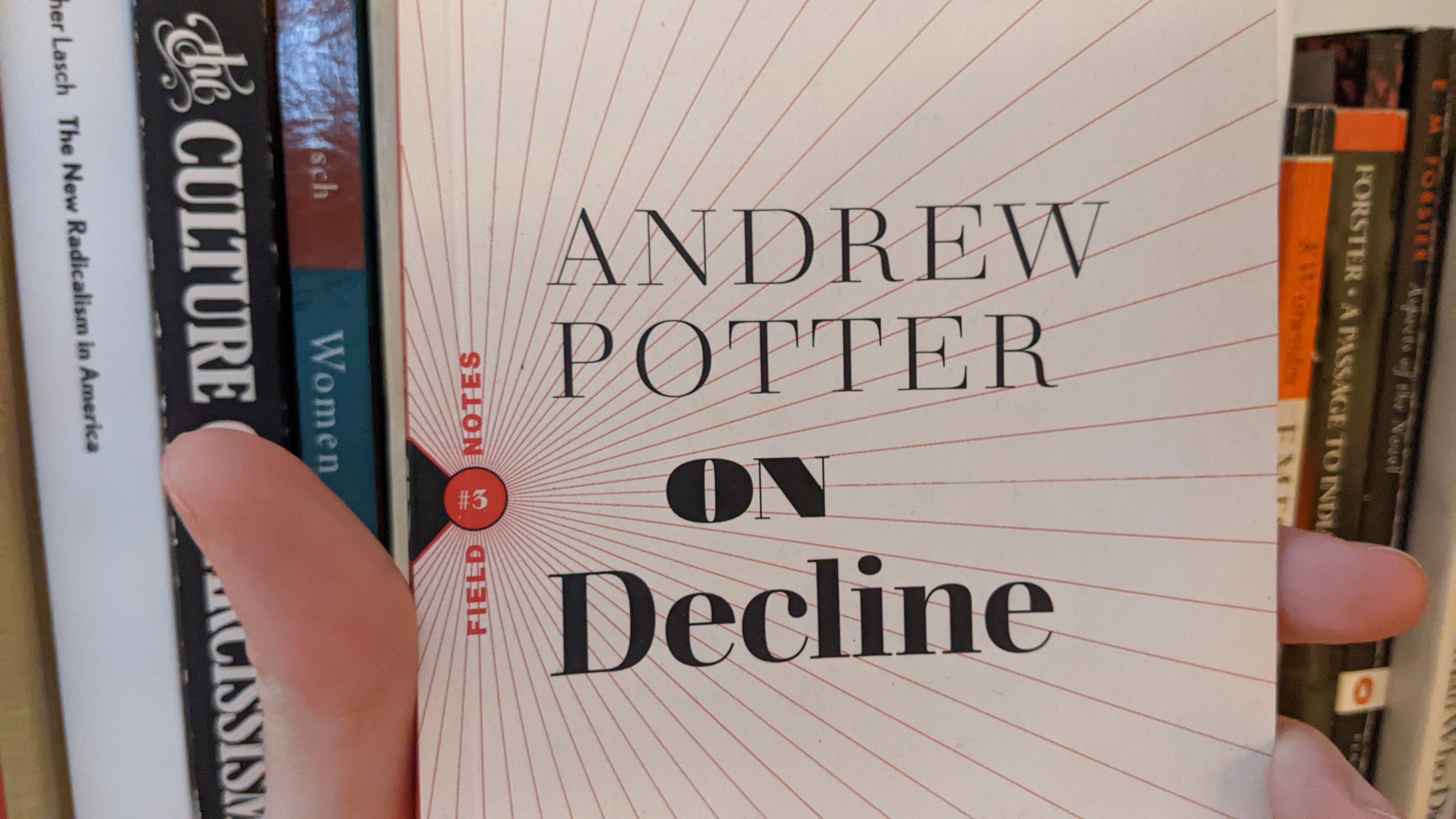
On Decline by Andrew Potter (book review)

Do you think we’re* in “decline”. This book argues that we are. Basically, economic stagnation breeds zero sum (your gain is my loss) thinking, playing into political tribalism which inhibits reason. All this taking place in a media environment (social media, smartphones and everything else designed as “casinos”) intended to short-circuit critical thought. That’s the overall argument. It’s heavy on “the enlightenment” and lacks for political and social context. That said, I was well prepared to dismiss the book but it kinda won me over. The basics of the analysis are true even if much is true in addition.

More content not saying I agree or disagree: we’re lucky to live in the current day rich world where “survival” isn’t a concern but… status seeking has replaced survival resulting in absurd behaviours and beliefs detached from practical reality. This can be generalized to the level of countries (for ex. Canada’s mismanagement of Covid-19 is papered over by how rich we are). The political right is the new counterculture** (flouting rules and conformity) while the left imposes new social rules. Smartphones and social media are genuinely more bad than good. “Democracy, technology and progress” once aligned but we’re out of “low hanging fruit”. Decline is not a matter of apocalypse but rather many different smaller problems amounting to one giant slow moving disaster.

*Who comprises the “we” anyway? Always a fun and uncontroversial question.

**His point is that the whole concept of “counterculture” is stupid though.

Northrop Frye on literature and imagination

“…modern writers speak of these visions of sacred golden cities and happy gardens very rarely, though when they do they clearly mean what they say. They spend a good deal more of their time on the misery, frustration or absurdity of human existence. In other words, literature not only leads us toward the regaining of identity, but it also separates this state from its opposite, the world we don’t like and want to get away from. The tone literature takes toward this world is not a moralizing tone, but the tone we call ironic. The effect of irony is to enable us to see over the head of a situation-we have irony in a play, for example, when we know more about what’s going on than the characters do-and so to detach at least in imagination, from the world we’d prefer not to be involved with.

As civilization develops, we become more preoccupied with human life, and less conscious of our relation to nonhuman nature. Literature reflects this, and the more advanced the civilization, the more literature seems to concern itself with purely human problems and conflicts. The gods and heroes of the old myths fade away and give place to people like ourselves. In Shakespeare we can still have heroes who can see ghosts and talk in magnificent poetry, but by the time we get to Beckett’s Waiting for Godot they’re speaking prose and have turned into ghosts themselves. We have to look at the figures of speech a writer uses, his images and symbols, to realize that underneath all the complexity of human life that uneasy stare at an alien nature is still haunting us, and the problem of surmounting it still with us.”

“…in literature you don’t just read one poem or novel after another, but enter into a complete world of which every work of literature forms part. This affects the writer as much as it does the reader. Many people think that the original writer is always directly inspired by life, and that only commonplace or derivative writers get inspired by books. That’s nonsense: the only inspiration worth having is an inspiration that clarifies the form of what’s being written, and that’s more likely to come from something that already has a literary form. We don’t often find that a poem depends completely on an allusion, as Chesterton’s poem does, but allusiveness runs all through our literary experience. If we don’t know the Bible and the central stories of Greek and Roman literature, we can still read books and see plays, but our knowledge of literature can’t grow, just as our knowledge of mathematics can’t grow if we don’t learn the multiplication table.”

….
“One of the things I’ve been trying to do in these talks is to distinguish the language of the imagination, which is literature, from two other ways of using words: ordinary speech and the conveying of information. It has probably occurred to you already that these three ways of using words overlap a good deal. Literature speaks the language of the imagination, and the study of literature is supposed to train and improve the imagination. But we use our imagination all the time: it comes into all our conversation and practical life: it even produces dreams when we’re asleep. Consequently we have only the choice between a badly trained imagination and a well trained one, whether we ever read a poem or not.

When you stop to think about it, you soon realize that our imagination is what our whole social life is really based on. We have feelings, but they affect only us and those immediately around us; and feelings can’t be directly conveyed by words at all. We have intelligence and a capacity for reasoning, but in ordinary life we almost never get a chance to use the intellect by itself. In practically everything we do it’s the combination of emotion and intellect we call imagination that goes to work. Take, for example, the subject that in literary criticism is called rhetoric, the social or public use of words. In ordinary life, as in literature, the way you say things can be just as important as what’s said. The words you use are like the clothes you wear. Situations, like bodies, are supposed to be decently covered. You may have some social job to do that involves words, such as making a speech or preaching a sermon or teaching a lesson or presenting a case to a judge or writing an obituary on a dead skinflint or reporting a murder trial or greeting visitors in a public building or writing copy for an ad. In none of these cases is it your job to tell the naked truth: we realize that even in the truth there are certain things we can say and certain things we can’t say.

Society attaches an immense importance to saying the right thing at the right time. In this conception of the ‘right thing,’ there are two factors involved, one moral and one aesthetic. They are inseparable, and equally important. Some of the right things said may be only partly true, or they may be so little of the truth as to be actually hypocritical or false, at least in the eyes of the Recording Angel. It doesn’t matter: in society’s eyes the virtue of saying the right thing at the right time is more important than the virtue of telling the whole truth, or sometimes even of telling the truth at all. We even have a law of libel to prevent us from telling some truths about some people unless it’s in the public interest. So when Bernard Shaw remarks that a temptation to tell the truth should be just as carefully considered as a temptation to tell a lie, he’s pointing to a social standard beyond the merely intellectual standards of truth and falsehood, which has the power of final veto, and which only the imagination can grasp.”

Media, status anxiety and advertising (history)

“The burgeoning of the mass media from the late nineteenth century helped to raise expectations even higher. At his newspaper’s launch in 1896, Alfred Harmsworth, the founder of Britain’s Daily Mail candidly characterised his ideal reader as a man in the street ‘worth one hundred pounds per annum’ who could be enticed to dream of being ‘tomorrow’s thousand pound man.’ In America, meanwhile, the Ladies’ Home Journal (first published in 1883), Cosmopolitan (1886), Munsey’s (1889) and Vogue (1892) brought an expensive life within the imaginative reach of all. Readers of fin de siècle American Vogue, for example, were told who had been aboard Nourmahal, John Jacob Astor’s yacht, after the America’s Cup race, what the most fashionable young ladies were wearing at boarding school, who threw the best parties in Newport and Southampton and what to serve with caviar at dinner (potato and sour cream).

The opportunity to study the lives of people of higher status and forge a connection with them was also increased by the development of radio, film and television. By the 1930s, Americans were collectively spending some 150 million hours per week at the cinema and almost a billion hours listening to the radio. In 1946, 0.02 percent of American households owned television sets; by 2000, the figure stood at 98 percent.

The new media created longings not only through their content but also through the advertisements they imposed on their audiences. From its amateurish beginnings in the United States in the 1830s, advertising had by the end of the nineteenth century grown into a business worth $500 million a year. In 1900, a giant Coca-Cola sign was erected on one side of Niagara Falls, while an advert for Mennen’s Toilet Powder was suspended over the gorge.”

Tony Blair on “globalisation” in 2005

“I hear people say we have to stop and debate globalisation. You might as well debate whether autumn should follow summer. They’re not debating it in China and India. They are seizing its possibilities, in a way that will transform their lives and ours. Yes, both nations still have millions living in poverty. But they are on the move. Or look at Vietnam or Thailand. Then wait for the South Americans, and in time, with our help, the Africans.

All these nations have labour costs a fraction of ours. All can import the technology. All of them will attract capital as it moves, trillions of dollars of it, double what was available even 10 years ago, to find the best return. The character of this changing world is indifferent to tradition. Unforgiving of frailty. No respecter of past reputations. It has no custom and practice.

It is replete with opportunities, but they only go to those swift to adapt, slow to complain, open, willing and able to change. Unless we “own” the future, unless our values are matched by a completely honest understanding of the reality now upon us and the next about to hit us, we will fail. And then the values we believe in become idle sentiments ripe for disillusion and disappointment.

In the era of rapid globalisation, there is no mystery about what works: an open, liberal economy, prepared constantly to change to remain competitive. The new world rewards those who are open to it. Foreign investment improves our economy. Or take immigration. We know we need strict controls. They are being put in place, along with identity cards, also necessary in a changing world. But one of the most satisfying things about the election was that the country saw through the Tories’ nasty, unprincipled campaign on immigration. People who come to work and make their lives here make Britain not weaker but stronger.

But there is a lesson here, too. The temptation is to use government to try to protect ourselves against the onslaught of globalisation by shutting it out – to think we protect a workforce by regulation, a company by government subsidy, an industry by tariffs. It doesn’t work today.

Because the dam holding back the global economy burst years ago. The competition can’t be shut out; it can only be beaten. And the greatest error progressive politics can make is to think that somehow this more open and liberal world makes our values redundant, that the choice is either to cling onto the European social model of the past or be helpless, swept along by the flow.

On the contrary, social solidarity remains the only way to secure the future of a country like Britain. However, today its purpose is not to resist the force of globalisation but to prepare for it, and to garner its vast potential benefits.”

Northrop Frye on “progress” and mortality

“The conception of progress grew up in the nineteenth century around a number of images and ideas. The basis of the conception is the fact that science, in contrast to the arts, develops and advances, with the work of each generation adding to that of its predecessor. Science bears the practical fruit of technology, and technology has created, in the modern world, a new consciousness of time. Man has doubtless always experienced time in the same way, dragged backwards from a receding past into an unknown future. But the quickening of the pace of news, with telegraph and submarine cable, helped to dramatize a sense of a world in visible motion, with every day bringing new scenes and episodes of a passing show. It was as though the ticking of a clock had become not merely audible but obsessive, like the tell-tale heart in Poe. The first reactions to the new sensation-for it was more of a sensation than a conception-were exhilarating, as all swift movement is for a time. The prestige of the myth of progress developed a number of value-assumptions: the dynamic is better than the static, process better than product, the organic and vital better than the mechanical and fixed, and so on. We still have these value-assumptions, and no doubt they are useful, though like other assumptions we should be aware that we have them. And yet there was an underlying tendency to alienation in the conception of progress itself. In swift movement we are dependent on a vehicle and not on ourselves, and the proportion of exhilaration to apprehensiveness depends on whether we are driving it or merely riding in it. All progressive machines turn out to be things ridden in, with an unknown driver.”

“…for most thoughtful people progress has lost most of its original sense of a favourable value-judgement and has become simply progression, towards a goal more likely to be a disaster than an improvement. Taking thought for the morrow, we are told on good authority, is a dangerous practice. In proportion as the confidence in progress has declined, its relation to individual experience has become clearer. That is, progress is a social projection of the individual’s sense of the passing of time. But the individual, as such, is not progressing to anything except his own death. Hence the collapse of belief in progress reinforces the sense of anxiety which is rooted in the consciousness of death. Alienation and anxiety become the same thing, caused by a new intensity in the awareness of the movement of time, as it ticks our lives away day after day. This intensifying of the sense of time also, as we have just seen, dislocates it: the centre of attention becomes the future, and the emotional relation to the future becomes one of dread and uncertainty. The future is the point at which ‘it is later than you think’ becomes ‘too late’. Modern fiction has constantly dealt, during the last century, with characters struggling toward some act of consciousness or self-awareness that would be a gateway to real life. But the great majority of treatments of this theme are ironic: the act is not made, or is made too late, or is a paralyzing awareness with no result except self-contempt, or is perverted into illusion.”

Bonus: Marshall McLuhan

“When you hear the word progress, you know you are dealing with a nineteenth-century mind. Progress literally stopped with electricity because you now have everything at once. You don’t move on from one thing at a time to the next thing. There is no more history; it’s all here. There isn’t any part of the past that isn’t with us, thanks to electricity. But it’s not thanks to print, it’s not thanks to photography, it’s thanks to electricity. Speed, huge speed-up, means there’s no more past. Now, there is no more history.”

2022 Edelman Trust Barometer – highlights

I’ve summarized (more like “highlighted”) the 2022 Edelman Trust Barometer, a world survey of public opinion. Canadian results are foregrounded.

-9 countries out of 27 surveyed sit at “all-time lows” of economic optimism and only 34% of Canadian respondents answered affirmatively to the prompt “My family and I will be better off in five years’ time”

-trust in social media has fallen sharply to just 37% globally (a stark 21% in Canada)

-Canada’s overall trust level (54%) is a full eleven points higher than the same indicator in the USA (43%)

-“distrust is the default” as 59% of respondents worldwide indicate a tendency to distrust

-48% of respondents globally say government is a “dividing force in society” and 52% affirmed that “Capitalism as it exists today does more harm than good in the world”

-big majorities in every country are worried about “fake news being used as a weapon”

-“Government leaders” are generally not trusted by respondents (42%) while “My coworkers” (74%) and “Scientists” (75%) sit at the other end of the trust spectrum

-large and growing majorities of respondents worry that “Journalists,” “government leaders” and “Business leaders” are “purposely trying to mislead people”

-USA: only 24% of Republicans trust the media vs. 55% of Democrats

-Germany and the Netherlands share two telling trends: falling overall trust and significant “trust inequality” (the gap in trust between high income and low income) Germans are also very distrustful of their central bank with only 47% of respondents indicating trust, the fourth lowest result of 27 countries