Byung-Chul Han on mind/body optimization and psychopolitics

“But neoliberalism, a further development -indeed, a mutated form- of capitalism, is not primarily concerned with ‘the biological, the somatic, the corporal’. It has discovered the psyche as a productive force. This psychic turn -that is, the turn to psychopolitics– also connects with the mode of operation of contemporary capitalism. Now, immaterial and non-physical forms of production are what determine the course of capitalism. What gets produced are not material objects, but immaterial ones -for instance, information and programs. The body no longer represents a central force of production, as it formerly did in biopolitical, disciplinary society. Now, productivity is not to be enhanced by overcoming physical resistance so much as by optimizing psychic or mental processes. Physical discipline has given way to mental optimization. And neuro-enhancement differs from the disciplinary techniques of psychiatry fundamentally.

Today, the body is being released from the immediate process of production and turning into the object of optimization, whether along aesthetic lines or in terms of health technology. Accordingly, orthopaedic intervention is yielding to aesthetic intervention. Foucault’s ‘docile body’ has no place in this production process. Cosmetic surgery and fitness studios are taking the place of disciplinary orthopaedics. That said, physical optimization means more than aesthetic practice alone: sexiness and fitness represent new economic resources to be increased, marketed and exploited.”

Bonus: Mark Fisher in Capitalist Realism

“Foucault painstakingly enumerated the way in which discipline was installed through the imposition of rigid body postures. During lessons at our college, however, students will be found slumped on desk, talking almost constantly, snacking incessantly (or even, on occasions, eating full meals). The old disciplinary segmentation of time is breaking down. The carceral regime of discipline is being eroded by the technologies of control, with their systems of perpetual consumption and continuous development.”
media notes #8: Benedict Anderson on newspapers

“In this perspective, the newspaper is merely an ‘extreme form’ of the book, a book sold on a colossal scale, but of ephemeral popularity. Might we say: one-day best-sellers? The obsolescence of the newspaper on the morrow of its printing -curious that one of the earlier mass-produced commodities should so prefigure the inbuilt obsolescence of modern durables- nonetheless, for just this reason, creates this extraordinary mass ceremony: the almost precisely simultaneous consumption (‘imagining’) of the newspaper-as-fiction. We know that particular morning and evening editions will overwhelmingly be consumed between this hour and that, only on this day, not that.

The significance of this mass ceremony -Hegel observed that newspapers serve modern man as a substitute for morning prayers- is paradoxical. It is performed in silent privacy, in the lair of the skull. Yet each communicant is well aware that the ceremony he performs is being replicated simultaneously by thousands (or millions) of others of whose existence he is confident, yet of whose identity he has not the slightest notion. Furthermore, this ceremony is incessantly repeated at daily or half-daily intervals throughout the calendar. What more vivid figure for the secular, historically clocked, imagined community can be envisioned? At the same time, the newspaper reader, observing exact replicas of his own paper being consumed by his subway, barbershop, or residential neighbours, is continually reassured that the imagined world is visibly rooted in everyday life.”

Bonus: Alexis de Tocqueville on newspapers

“The effect of a newspaper is not only to suggest the same purpose to a great number of persons, but to furnish means for executing in common the designs which they may have singly conceived. The principal citizens who inhabit an aristocratic country discern each other from afar; and if they wish to unite their forces, they move towards each other, drawing a multitude of men after them. In democratic countries, on the contrary, it frequently happens that a great number of men who wish or who want to combine cannot accomplish it because as they are very insignificant and lost amid the crowd, they cannot see and do not know where to find one another. A newspaper then takes up the notion or the feeling that had occurred simultaneously, but singly, to each of them. All are then immediately guided towards this beacon; and these wandering minds, which had long sought each other in darkness, at length meet and unite. The newspaper brought them together, and the newspaper is still necessary to keep them united.”

Raymond Williams: ‘Mobile Privatization’

“There is then a unique modern condition, which I defined in an earlier book (Television: technology and cultural form, 1974) as ‘mobile privatization’. It is an ugly phrase for an unprecedented condition. What it means is that at most active social levels people are increasingly living as small-family units, or, disrupting even that, as private and deliberately self-enclosed individuals, while at the same time there is quite unprecedented mobility of such restricted privacies. In my novel Second Generation (1964) I developed the image of modern car traffic to describe this now dominant set of social relations in the old industrial societies. Looked at from right outside, the traffic flows and their regulation are clearly a social order of a determined kind, yet what is experienced inside them -in the conditioned atmosphere and internal music of this windowed shell- is movement, choice of direction, the pursuit of self-determined private purposes. All the other shells are moving, in comparable ways but for their own different private ends. They are not so much other people, in any full sense, but other units which signal and are signalled to, so that private mobilities can proceed safely and relatively unhindered. And if all this is seen from outside as in deep ways determined, or in some sweeping glance as dehumanised, that is not at all how it feels like inside the shell, with people you want to be with, going where you want to go.”

Bonus: Dahlia Lithwick on the Canadian truckers protest

“Many observers have noted that weaponizing trucks as machines of occupation was what was radically new about the Freedom Convoy, and that is partly true. Trucks are not just a signifier of economic realities, but also mobile units in which one can live and move, almost wholly oblivious to the world around you, if you so choose. You can build your own ecosystem, communicate solely with like-minded souls, broadcast your own reality, and emerge only to demand unmasked service in local restaurants and shops.

The enduring lesson of the Ottawa occupation was that such arrangements not only shelter individuals from the genuine suffering that happens all around but can also lead them to an information deficit that confirms any belief.”

media notes #7: Sound/History by Rick Altman

What is cinema? If when considering cinema you only account for “image” then there’s an obvious history, but “cinema’s sound identity has undergone constant redefintion.” In cinema’s early -pre-1930’s- period, it combined with various audio media to the extent that they cannot be seen separately.

Media is constantly changing, be wary of projecting the current conception onto the past. Because it combines “image and sound technologies” film can integrate or “blend in” any relevant new technique that “serves a particular aesthetic or economic purpose.”

“Nickelodeons” were largely a silent format -a matter of “moving photographs” on literal film. The “familiar audio/visual phenomenon we now call cinema” is not present at this early moment. Soon after however, films began to be shot “in view of a specific accompaniment.” As the cliché has it “the silents were never silent.”

The “phonograph” or “graphophone” was then combined with “the picture machine” to create “the singing and talking moving picture.” This process is primarily identified with the company Cameraphone who initiated the “star system” via their “decision to record vaudeville on film.” However, “it would take nearly two decades to install a durable sound film system.”

“We make more sense of the film industry by understanding it as a complex of related production strategies.” Thanks to this dynamism, early film “could pass rapidly from opera to cartoons and back.”

“Televison was referred to as radio throughout the twenties.” With regards to film and radio “the borders of the media remained an open question” and they had not “definitively separated” by 1922. Film audio was simulcast over radio to multiple theaters in the “Rothacker process.”

The “Victrola” was a “revolution in the phonograph field.” Early sound films “were an outgrowth of the record industry” and emphasized audio, “a telephone, plus a phonograph plus a radio” as one critic put it. “What is a talking picture but a phonograph record with plenty of amplification behind it?” wrote another.

“Representational technologies” like the above audio/visual innovations “take on multiple identities,” are “constantly redefined” and “are subject to the vagaries of reception.” This is opposed to simple notions of “substitution” or “succession”. “Equivalence and improvement in one area are accompanied by a zone of non-equivalence in another.”

Cinema’s history of “conflation with other media” precludes any notion of a succession of “true equivalents.” “Representational technologies” tend “toward multiple definition,” in the case of early cinema “as a circus,” an “exhibition,” or “theater.” In the history of cinema definition is a multifaceted “ongoing struggle” of “jurisdiction.”

media notes #6: Adorno on stereotypes and TV

Stereotypes “are an indispensable element of the organization and anticipation of experience, preventing us from falling into mental disorganization and chaos, no art can entirely dispense with them.”

But “reified and rigid” stereotypes are a threat in the present “setup of cultural industry.” “The more opaque and complicated modern life becomes, the more people are tempted to cling desperately to clichés which bring some order…”

“We should never forget that there are two sides to every psychodynamic phenomenon, the unconscious or id element and the rationalization.” The latter can be legitimate, but even where legitimate, as in moral messages that are cheesy but positive and true, “mechanical oversimplifications” risk “distorting.”

“The standard device employed is that of the spurious personalization of objective issues.” Personalization of issues is necessary but not to the extent of presenting “individuals as mere specimens of an abstraction.” TVs “phony psychology of the big shots” leads to identification with power.

Two examples of stereotypes in mass culture: “a pretty girl can do no wrong” and is “exploitative, demanding” etc. and the artist as a “maladjusted, introverted” weakling in contrast to the “man of action.”

“As happens frequently in mass culture, the roles of the sexes are reversed -the girl is utterly aggressive, and the boy, utterly afraid of her, describes himself as ‘woman-handled’ when she manages to kiss him.”

These “illustrations and examples” are not new but they are newly relevant in light of “the cultural and pedagogical problem presented by television.” The aim is to knowingly “face psychological mechanisms operating on various levels in order not to become blind and passive victims.”

The Roles of Radio by Harold Mendelsohn – Summary Essay

The following is a summary of The Roles of Radio by Harold Mendelsohn.

Radio functions as a “diverting companion” and fills the void during routine and boring tasks as well as consoling feelings of social isolation and loneliness. It can also add an “adult” voice for those starved of such, like mothers of young children.

“Radio serves as a reliable, nonthreatening, pleasant human surrogate” that keeps listeners “in touch” with social “realities.” The wide variety of stations make radio adaptable to the listening “mood or psychological frame of mind.” This mood function serves to both sustain and create.

Radio listeners do not tire of listening to the same news over and over again, whether new details are added or not. News radio provides a sense of vicarious participation in “the great events of the day.” “In a world of overwhelming complexity where the role of the individual in shaping events is becoming ever more remote, ‘keeping up’ with the news easily becomes a substitute” for involvement.

“Radio allows the listener to “participate” psychologically in the news events of the day” and “share with others a wide variety of events of common interest.” The “talk” content of radio is “social lubricant” as it provides listeners with subjects of conversation. In this way, casual communication between people is made easier.

Click here for a summary of Understanding Radio by Marshall McLuhan. It’s a much more intense analysis of radio that asserts the medium’s “tribal” effects.

Understanding Radio by Marshall McLuhan – Summary Essay

The following is a summary of Understanding Radio by Marshall McLuhan

England and America were immunized against radio by their long histories of literacy and industrialism. Their “intense visual organization” contrasted with the “more earthy and less visual European cultures.” There, the “tribal drum” of radio is “magic” and “began to resonate with the note of fascism.” Highly literate people were bewildered.

Radio listeners are deeply involved, people “carry transistor sets in order to provide a private world for themselves amidst crowds.” “Radio affects people most intimately, person-to-person, offering a world of unspoken communication between speaker and listener.”

Hitlers rise to power was “directly owing to radio.” “Radio provided the first massive experience of electronic implosion: that reversal of the entire direction and meaning of literate Western civilization.” Highly literate societies “have managed to absorb and to neutralize the radio implosion,” elsewhere the exposure is “utterly explosive.”

Typographic technology and literacy represent one grand logic that impacts societies key components. “Continuity, uniformity, repeatability” had permeated England and America. In contrast, the middle-European world had “ready access” to the rich non-visual resources of auditory and tactile form and felt “the hot impact of radio.” “The message of radio is one of violent, unified implosion and resonance.”

Literacy “fostered an extreme of individualism” while radio revived “the ancient exposure of kinship webs of deep tribal involvement.” Radio “is really a subliminal echo chamber of magical power to touch remote extensions of ourselves and forgotten chords.” Radio is “an extension of the central nervous system that is matched only by human speech itself.”

“The phonetic alphabet and the printed word exploded the closed tribal world into the open society of fragmented functions and specialist knowledge.” Radio has the power to “retribalize mankind.” This has gone virtually unremarked upon and that itself is what needs explaining.

Click here for a summary of The Roles of Radio by Harold Mendelsohn. It’s a much less intense analysis of radio focused on everyday consumption.

media notes #3: Media Hot and Cold by Marshall McLuhan

A “hot medium” extends one single sense in high definition. “High definition is the state of being well filled with data.” Speech is a cool medium because “so much has to be filled in by the listener.” “Hot media” “do not leave so much to be filled in.” “Hot media are, therefore, low in participation, and cool media are high in participation.”

The printed word broke up the old medieval social structure with its “individualistic patterns.” The “hotting-up of the medium of writing to repeatable print intensity led to nationalism and the religious wars of the sixteenth century.” Stone bound time, print unified spaces and the ages.

Intensity and high definition engender specialism and fragmentation. We can’t accept every shock to our sensibility fully and directly so a “cooling system” is necessary, particularly in periods of technological change.

Old hierarchies collapse in the face of hot mediums. On the other hand, media like radio send societies back in time as “nonspecialist electric technology retribalizes.” “The instant speed of electricity confers the mythic dimension on ordinary industrial social action today.”

Quotes about revolution

“It is a know fact that almost all revolutions have been the work, not of the common people, but of the aristocracy, and especially of the decayed part of the aristocracy.” -Pareto

“Revolutions are the locomotives of history.” -Marx

“The bourgeois revolutions of the past required from the universities merely lawyers as the best raw material for politicians; the emancipation of the working class needs, besides, physicians, chemists, agronomists and other specialists; for it is a question not only of leading in the political machinery but also of taking the entire production of society in hand; and here, in place of high-sounding phrases, solid knowledge is needed.” -Engels

“I only know of one France. That of the Revolution. That of Toussaint L’Ouverture. Too bad for the Gothic cathedral.” -Césaire

“Every collective revolution rides in on a Trojan horse of ‘Emergency.’ It was the tactic of Lenin, Hitler, and Mussolini. This technique of creating emergency is the greatest achievement that demagoguery attains.” -Hoover

“My principles are only those that, before the French Revolution, every well-born person considered sane and normal.” -Evola

“A revolution is not a dinner party.” -Mao

“A revolutionary career does not lead to banquets and honorary titles, interesting research and professorial wages. It leads to misery, disgrace, ingratitude, prison and a voyage into the unknown, illuminated by only an almost superhuman belief.” -Horkheimer

“There is a Satanic element in the French Revolution which distinguishes it from any other revolution known or perhaps that will be known.” -de Maistre

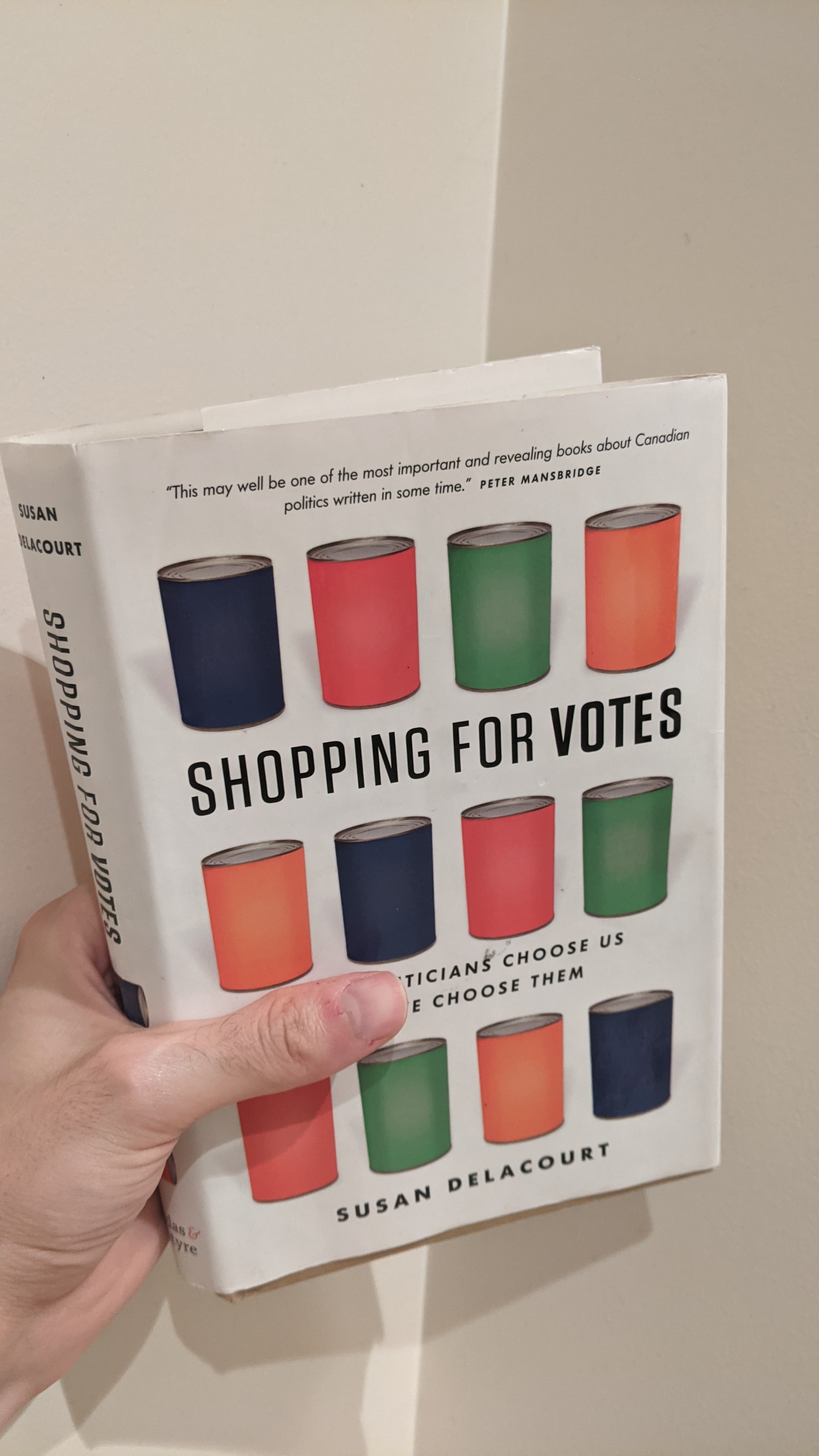
Canadian history and politics #6: Shopping for Votes: How Politicians Choose Us and We Choose Them by Susan Delacourt – 2013

Shopping for Votes traces the history that led to the current state of “political marketing”. “Floating”, uninformed and shallow voters without party loyalty are the election clinching prize for campaign strategists who endlessly segment the public at large.

It seems clear the 80’s and 90’s were the key decades in this process. Greater cynicism about politics and politicians, reduced belief in the efficacy of the public sector and a paradigm shift in marketing and branding combined with a right-turn in popular ideology to create a new atmosphere of futility.

In the 2000’s (says Delacourt) the logic of political marketing reached an unprecedented low: a brave new world where the Harper Conservatives began targeting just 100,000 people across the entire country during federal elections, shunning national polling.

This book combines pop-theory wokeness (Gramsci, Baudrillard and even Adam Curtis are cited) and well meaning small-d democratic idealism into a critique of the trends in question. The author seems to desire a categorical change in party politics, neglecting matters of degree and the brutal reality of quotidian incentives and pressures.